
























When you first watch an authentic ’80s movie, a new feeling overcomes you. Suddenly, you are transported to a new, yet older world. Synth, love, disorder; everything is different from reality, but it is all something more than an illusion. The people are real. John: just a boy who is misunderstood and really does not want to be at Sunday school. Andie: totally ignoring Ducky’s attempts at a real relationship. Ferris: running in and out of backyards, causing chaos, running amok, and dodging school authorities. Moreover, last but not least, Kevin: throwing paint cans down the stairs to try to harm a silly set of burglars violently. These are characters from some of our favorite movies:
He was the creator not only of the beloved “cleshay” ’80s movie, but also of society’s favorites, including National Lampoon’s Family Vacation and Uncle Buck. John Hughes flipped the scripts with new actors, brought together a legacy of icons, and defined the necessary principles of the coming-of-age film. As a director, he strived to portray adolescence as more than just a stage of life, but as an adventure. Say hello to John Hughes’ way and learn how his movies formed the decade. Let us start at the beginning. Before Hughes stepped up to the plate, teens were seen as irrational with hormonal issues.
Movies, chiefly in the 50s, portrayed teens as so rebellious that they were completely made up and unconnected characters. “At the time I came along, Hollywood’s idea of teen movies meant there had to be much nudity…Either that or a horror movie. Moreover, the last thing Hollywood wanted in their teen movies was teenagers!” Hughes commented on the teen movies before him. People would much rather watch movies about adults who knew the rules of society, had real problems, and had real feelings. It was time to break the stereotype of the average “crazy” teenager, and that is what Hughes did.
Hughes directed Sixteen Candles in 1984; the dawn of a true teen drama. Samantha, turning 16, likes Jake the jock. However, Ted, the nerd, is the only one with actual feelings for her. This boy-likes-girl-likes-other-boy storyline is the baseline of a few of his other films as well. As a great success for this low-budget film, it launched the main actors, Anthony Michael Hall and Molly Ringwald, into fame. In fact, these two actors were cast in Hughes’ next famous film, The Breakfast Club. The movie displayed five teenage characters: the nerd, the popular girl, the jock, the bad boy, and the outcast. While it may seem that this movie reinforced stereotypes, it actually resonated with many viewers, grossing $51 million at the box office. These characters resonated with teens; it was as if every type of person was represented. Hughes successfully displayed teens as real-life people. Sure, they were young and did not act like adults, but Hughes emphasised how everyone has their own problems, no matter how they live. Whether they are big or small, “teen problems” were just as valid as “adult problems.”
Meet the Brats
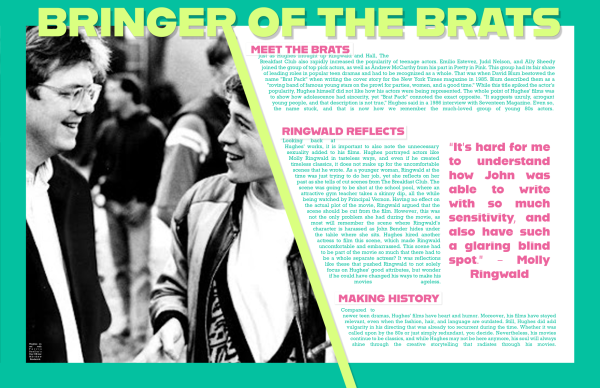
Just as Hughes brought up Ringwald and Hall, The Breakfast Club also rapidly increased the popularity of teenage actors. Emilio Estevez, Judd Nelson, and Ally Sheedy joined the group of top pick actors, as well as Andrew McCarthy from his part in Pretty in Pink. This group had its fair share of leading roles in popular teen dramas and had to be recognized as a whole. That was when David Blum bestowed the name “Brat Pack” when writing the cover story for the New York Times magazine in 1985. Blum described them as a “roving band of famous young stars on the prowl for parties, women, and a good time.” While this title spiked the actor’s popularity, Hughes himself did not like how his actors were being represented. The whole point of Hughes’ films was to show how adolescence had sincerity, yet “Brat Pack” connoted the exact opposite. “It suggests unruly, arrogant young people, and that description is not true,” Hughes said in a 1986 interview with Seventeen Magazine. Even so, the name stuck, and that is now how we remember the much-loved group of young 80s actors.
Ringwald Reflections
Looking back at Hughes’ works, it is important to also note the unnecessary sexuality added to his films. Hughes portrayed actors like Molly Ringwald in tasteless ways, and even if he created timeless classics, it does not make up for the uncomfortable scenes that he wrote. As a younger woman, Ringwald at the time was just trying to do her job, yet she reflects on her past as she tells of cut scenes from The Breakfast Club. The scene was going to be shot at the school pool, where an attractive gym teacher takes a skinny dip, all the while being watched by Principal Vernon. Having no effect on the actual plot of the movie, Ringwald argued that the scene should be cut from the film. However, this was not the only problem she had during the movie, as most will remember the scene where Ringwald’s character is harassed as John Bender hides under the table where she sits. Hughes hired another actress to film this scene, which made Ringwald uncomfortable and embarrassed. This scene had to be part of the movie so much that there had to be a whole separate actress? It was reflections like these that pushed Ringwald to not solely focus on Hughes’ good attributes, but wonder if he could have changed his ways to make his movies ageless.
Making History
Compared to newer teen dramas, Hughes’ films have heart and humor. Moreover, his films have stayed relevant, even when the fashion, hair, and language are outdated. Still, Hughes did add vulgarity in his directing that was already too recurrent during the time. Whether it was called upon by the 80s or just simply redundant, you decide. Nevertheless, his movies continue to be classics, and while Hughes may not be here anymore, his soul will always shine through the creative storytelling that radiates through his movies.